
About This Item
- Full text of this item is not available.
- Abstract PDFAbstract PDF(no subscription required)
Share This Item
The AAPG/Datapages Combined Publications Database
Houston Geological Society Bulletin
Abstract
Abstract: Multidisciplinary Reservoir Description to
Characterize Connectivity in a Complex Minibasin
Fill: An Integrated Approach at Holstein Field
BP America Inc.
Holstein is a BP-operated, deepwater oil field located in the
Gulf of Mexico. Reservoirs comprise stacked, Pliocene turbidite
sands with the field formed by a
large, steep, southeasterly dipping, monoclinal
structure. Early performance of the
field showed a sharper production decline
than predicted by the sanction study.
Dynamic simulation of early wells suggested
limited drainage acreage confined by baffle
regions with limited connection to the
larger reservoir. A campaign of surveillance
data was carried out. Subsequent drilling
indicated the reservoirs, originally modeled
as being in pressure isolation, were
experiencing pressure-depletion through
connections  between
 reservoirs. A major
effort was undertaken to recharacterize the reservoir, rebuild the
static model and generate new dynamic simulations to update
the development strategy and develop a mitigation plan.
reservoirs. A major
effort was undertaken to recharacterize the reservoir, rebuild the
static model and generate new dynamic simulations to update
the development strategy and develop a mitigation plan.
The sanction case geological model described the reservoir sands
as deposited in a ponded, intraslope salt basin dominated by
thick, amalgamated reservoirs with internal homogeneity and
excellent connectivity. The subsequent recharacterization
describes reservoir architecture elements
composed of sandy sheets and channels that
shingle to form genetically related reservoirs.
Baffling between geobodies and
pressure-isolated compartments between
some shingles are also recognized. Postdepositional
modification of the reservoir
further complicates well performance by
removing the reservoir entirely or reducing
its thickness. A structural overprint creates
deformation bands that appear to reduce
well productivity through the reduction of
effective permeability in the structurally
steepest segment of the field. In addition,
seismically resolvable faults, originally thought to be sealing, are
modeled as having variable transmissibility and allowing cross-flow
between the complex reservoirs.
End_Page 13---------------
A revised heterogeneity
model calibrated with
dynamic data allowed
greater understanding of
the well performance variations.
The assisted
history-match approach of
Top-Down Reservoir
Modeling (TDRM) was
utilized to handle the main
uncertainties in the field
and reach multiple models
with a good match to all
production and pressure
data available. These models allowed the analysis of production
strategies for optimizing recovery. The data that guided this model
rebuild, the integrated modeling process used, and the resulting
impacts on the depletion plan are described in this work.
 Figure 1.
Location of the Holstein Field with other numerous discoveries, planned
developments and existing production within BP’s Gulf of Mexico deepwater
portfolio.
Figure 1.
Location of the Holstein Field with other numerous discoveries, planned
developments and existing production within BP’s Gulf of Mexico deepwater
portfolio. Figure 2.Well
logs from the sidetrack to the discovery well (GC 644#1 ST1) with informal
reservoir nomenclature indicated. MDT pressure vs. depth plots indicate
reservoirs exist in pressure-isolated compartments. Field outline indicated on
struacture map to right.
Figure 2.Well
logs from the sidetrack to the discovery well (GC 644#1 ST1) with informal
reservoir nomenclature indicated. MDT pressure vs. depth plots indicate
reservoirs exist in pressure-isolated compartments. Field outline indicated on
struacture map to right.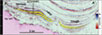 Figure 3.
Structural cross section A-A’; location shown in figure 2. Oriented
northwest-southeast showing the field in profile with the terrace, ramp and
trough labeled. Reservoirs are shown in yellow and allocthonous salt is
interpreted in pink. Modified from Tom Byrd.
Figure 3.
Structural cross section A-A’; location shown in figure 2. Oriented
northwest-southeast showing the field in profile with the terrace, ramp and
trough labeled. Reservoirs are shown in yellow and allocthonous salt is
interpreted in pink. Modified from Tom Byrd.
 Figure 4. This
basin fill model describes the back-stepping nature of the reservoirs with older
sands at the bottom, younger to the top. The basin depocenter migrated SE to NW
due to differential
Figure 4. This
basin fill model describes the back-stepping nature of the reservoirs with older
sands at the bottom, younger to the top. The basin depocenter migrated SE to NW
due to differential . allochthonous salt withdrawal. Individual reservoirs are
segregated from one another by fine-grained turbiditic silts asands and shales.
. allochthonous salt withdrawal. Individual reservoirs are
segregated from one another by fine-grained turbiditic silts asands and shales.
 Figure 5.
Seismic facies are used to generate an architectural elements (or reservoir
depositional environment) map which shows the internal facies heterogeneity of
individual fans. In addition to the depositional elements, we capture the
post-depositional erosional zero edges.
Figure 5.
Seismic facies are used to generate an architectural elements (or reservoir
depositional environment) map which shows the internal facies heterogeneity of
individual fans. In addition to the depositional elements, we capture the
post-depositional erosional zero edges.End_of_Record - Last_Page 15---------------