
The AAPG/Datapages Combined Publications Database
AAPG Bulletin
Figure
AAPG Bulletin; Year: 2026; Issue: January DOI: 10.1306/11132524122
Return to Full Text
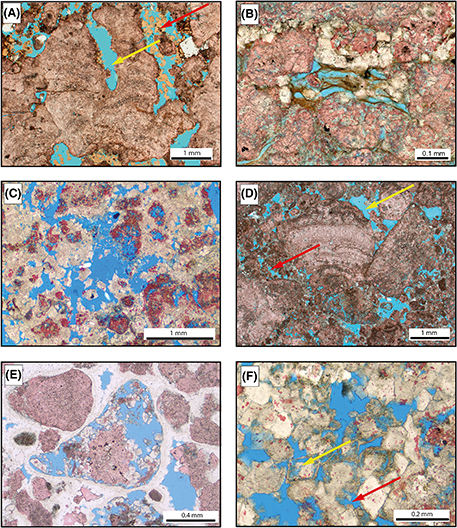
Figure 9. Main types of pores identified in the studied rocks. (A) Interaggregate (yellow arrow) and vugular porosity with remnants of peloidal matrix (red arrow) in shrubstone (uncrossed polarizers, //P). (B) Pores from shrinkage of the laminated clay matrix, partially replaced by blocky dolomite (//P). (C) Vugular porosity, partially reduced by dolomite cementation (//P). (D) Interparticle, intraparticle (red arrow), and vugular porosity (yellow arrow) in intraclastic rock (//P). (E) Detail of intraparticle porosity due to intraclast dissolution in intraclastic calcarenite cemented by silica (//P). (F) Detail of intercrystalline (red arrow) and intracrystalline (yellow arrow) porosity in dolomite (//P).
Figure 9. Main types of pores identified in the studied rocks. (A) Interaggregate (yellow arrow) and vugular porosity with remnants of peloidal matrix (red arrow) in shrubstone (uncrossed polarizers, //P). (B) Pores from shrinkage of the laminated clay matrix, partially replaced by blocky dolomite (//P). (C) Vugular porosity, partially reduced by dolomite cementation (//P). (D) Interparticle, intraparticle (red arrow), and vugular porosity (yellow arrow) in intraclastic rock (//P). (E) Detail of intraparticle porosity due to intraclast dissolution in intraclastic calcarenite cemented by silica (//P). (F) Detail of intercrystalline (red arrow) and intracrystalline (yellow arrow) porosity in dolomite (//P).