
About This Item
- Full TextFull Text(subscription required)
- Pay-Per-View PurchasePay-Per-View
Purchase Options Explain
Share This Item
The AAPG/Datapages Combined Publications Database
GCAGS Transactions
Abstract
Petrology and Geochemistry of Calcite Precipitates and Water from Surface and Spelean Environments, Central Texas: Analogs for Non-Marine Carbonate Cements
ABSTRACT
Aggregate calcite crystal rafts (Fig. 1) form quickly (<12 hours to a few months) at the air-water inter-face in a surface stream and cave pools in Central Texas. Crystal lengths range from 10 to 100 µ. Common crystal habits forming in cave pools include equant to subequant rhombohedrons (l:w  1:1) (Fig. 2A) and elongate trigonal prisms (l:w 5:1) in straight bundles (Fig. 2B) and spherulitic hemispheres (10 µ dia) (Fig. 3A and 3B). More elongate crystals precipitate from the more highly saturated waters. Multiple round and angular holes, 10 µ in diameter, in faces of equant to subequant spelean crystals (Fig. 4A) are interpreted to be of constructional genesis around gas bubbles or particles (Fig. 4B).
Equant dodecahedrons and rhombohedrons compose rafts that form on the top of the surface stream (Fig. 5). Ubiquitous single round holes appear to penetrate the crystal structure and are probably molds of algal filaments.
The skeletal crystals (hollow cores) of thermal travertine systems (Chafetz et al., 1991; Jones and Renaut, 1996) have not been found in either environment. In contrast, unusual crystals with well-formed faces and incomplete edges are common (Fig. 6). The crystals with incomplete edges resemble "edge-guttered" crystals illustrated in Folk et al. (1985). SEM analyses at the micron scale have not revealed any evidence to support microbially induced mineral precipitation (e.g., clusters, chains of spheres, or rods).
Contemporaneous sampling of calcite and the water from which it precipitated provided paired samples for geochemical analyses. Analytical results provide evidence of temporal and areal variability in the samples. In fact the precipitates are rarely in chemical or isotopic equilibrium with the water in which they form, probably due to rapid or energetic CO2 degassing or evaporation. In only about half of the cases shown in Figure 7 do the calcites precipitate near geochemical equilibrium conditions as indicated by the saturation indices (SI) of the waters. Saturation index with respect to calcite is expressed as SIc and is calculated as the ion activity product (IAP) of the solution divided by the calcite equilibrium constant (K) or SIc = IAP/K. Oxygen isotopic equilibrium is observed in only a few cases,  18OSMOW: -6 to 0 (Fig. 8) and 13CPDB ranges from -15 to -3 (not shown).
Calcite rafts--analogs for pure non-marine carbonate cements--have received little research attention and have been mentioned only briefly in the literature (Hanor, 1978; Chafetz and Butler, 1980; Chafetz et al., 1991; Gonzalez et al., 1992). Because the crystals are not obscured by sediment, rafts provide an excellent source of material for detailed petrographic and geochemical analyses and thus provide valuable insights with regard to other environmental parameters.
End_Page 935------------------------
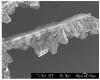 Figure 1. Typical raft of calcite crystals collected from the water surface in a cave pool. The top surface forms at the air-water interface and is relatively flat but the bottom surface develops high relief as crystals grow downward into the water.
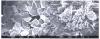 Figure 2. Two common crystal habits include equant (A) and elongate trigonal prisms (B). Scale bars are 40 microns for A and 20 microns for B.
 Figure 3. Radiating aggregate crystals of calcite at two different magnifications. View in A shows one bundle on its "side," top surface to the right. B shows bottom view of crystals. Scale bars are 100 microns for A and 10 microns for B.
End_Page 936------------------------
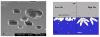 Figure 4. A) Round to angular holes in the faces of equant to subequant crystals reveal evidence of crystal growth around some obstructions as seen in the holes as straight edges and sharp angles between faces of crystallites. B) The round holes are interpreted to have formed around gas bubbles. Left: waters with a low SIc produce dense rafts of equant crystals, which block the escape of the bubbles. Calcite forms around the trapped bubble. Right: super-saturated waters (high SIc) produce rapidly precipitated open-structure rafts of elongate crystals with multiple openings that allow gas to escape.
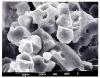 Figure 5. Equant rhombohedral and dodecahedral crystals compose rafts from the surface stream. Note abundance of holes, but these holes tend to penetrate the crystals and probably formed around algal filaments.
 Figure 6. Crystals with well-developed faces and incomplete edges (juncture of two faces) are common. These edges show no signs of dissolution (rounding or pitting).
End_Page 937------------------------
 Figure 7. The saturation index (SI) of water from which calcite precipitated is shown for several samples. SIc=1 (horizontal line) represents geochemical equilibrium. Obviously most of the waters are supersaturated with respect to calcite (i.e., the calcite is deposited under disequilibrium conditions).
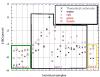 Figure 8. The measured variability in oxygen isotopic values for water, calculated theoretical calcite, and calcite that precipitated at the water surface (rafts) and on artificial substrates placed in the water (glass slides and beads) are shown for three field areas. Samples from each area are outlined by a box: Surface Stream (green), Cave 1 (black), and Cave 2 (yellow). Data in each vertical column are from paired samples at an individual site. Isotopic values of precipitates are almost always higher than the theoretical.
End_Page 938------------------------
Pay-Per-View Purchase Options
The article is available through a document delivery service. Explain these Purchase Options.
| Watermarked PDF Document: $14 | |
| Open PDF Document: $24 |