
About This Item
- Full TextFull Text(subscription required)
- Pay-Per-View PurchasePay-Per-View
Purchase Options Explain
Share This Item
The AAPG/Datapages Combined Publications Database
AAPG Bulletin
Abstract
(Begin page 372)
AAPG Bulletin, V.
NORTH AMERICAN COMMISSION ON STRATIGRAPHIC NOMENCLATURE
NOTE 64--Application for revision of articles 48-54,
 biostratigraphic
 units, of the North American Stratigraphic Code (NORTH AMERICAN COMMISSION ON STRATIGRAPHIC NOMENCLATURE)
biostratigraphic units, of the North American Stratigraphic Code (NORTH AMERICAN COMMISSION ON STRATIGRAPHIC NOMENCLATURE)Alfred C. Lenz, Department of Earth Sciences, University of Western Ontario, London, Ontario, N6A 5B7, Canada; Lucy E. Edwards, U.S. Geological Survey, 970 National Center, Reston, Virginia, 22092; and Brian R. Pratt, Department of Geological Sciences, University of Saskatchewan, Saskatoon, Saskatchewan, S7N 5E2, Canada
Manuscript received January 31, 2000; revised manuscript received
March 9, 2000; final acceptance June 30, 2000.
[Editor's Comment: This Note 64 is a recommended complete replacement of
Articles 48 through 54 of the North American Stratigraphic Code (NACSN, 1983).]
INTRODUCTION
The current version of the North American Stratigraphic Code was published sixteen
years ago (NACSN, 1983), and the section on biostratigraphic units has remained unchanged
since that time. The publication of the revised version of the International Stratigraphic
Guide (Salvador, 1995) and comments from the biostratigraphic community have led us to
conclude that changes in the biostratigraphic section of the Code are warranted.
Improvements proposed herein include a clear-cut statement that the biozone is,
fundamentally, the only biostratigraphic unit; that the biozone may be both defined and
characterized; that it is expressly because of organic evolution that fossil species and
their associations are unique and nonrepetitive through the stratigraphic column; and that
the biozone, unlike many other stratigraphic units, does not have a stratotype. Other
changes include a clarification of shortened forms of expression and the revision of some
diagrams illustrating the various kinds of biozones to make them clearer and less
ambiguous.
In 1996, an ad hoc committee comprising the three authors listed previously, with A. C.
Lenz serving as chair, began work on the revision of the Biostratigraphic Units section of
the Code. The resulting revision is presented below.
In this revision, we have incorporated ideas and specific phrasing from the International Stratigraphic Guide. We are grateful for comments on this revision from colleagues, especially A. Salvador and M. Murphy.
RECOMMENDATION
In compliance with Article 21, ["--changes of this code may be proposed in writing to the Commission by any geoscientist at any time. If accepted for consideration by a majority vote of the Commission, they may be adopted by a two-thirds vote of the Commission at an annual meeting not less than a year after publication of the proposal."
(NACSN, 1983)]. We recommend that Articles 48 through 54 be revised as proposed, and we invite comments from the geologic community on this proposal. Those comments should be directed to A. C. Lenz, Department of Earth Sciences, University of Western Ontario, London, Ontario N6A 5B7, Canada. Fax: 519 661 3198; email: <[email protected]>.
BIOSTRATIGRAPHIC UNITS
PREAMBLE
Article 48.--Fundamentals of Biostratigraphy. Biostratigraphy is the
branch of stratigraphy that deals with the distribution of fossils in the stratigraphic
record and the classification of bodies of rock or rock material into biostratigraphic
units based on their contained fossils.
Remark. (a) Uniqueness.--Biostratigraphic units are distinct from all other
kinds of stratigraphic units because organic evolution has produced a unique and
nonrepeated sequence of fossils in the stratigraphic record.
NATURE AND BOUNDARIES
Article 49.--Nature of Biostratigraphic Units. A biostratigraphic unit is a body
of rock or rock material that is defined or characterized by its fossil content.
Remarks. (a) Unfossiliferous rocks.--Those bodies of rock lacking named fossils
have no biostratigraphic character and are, therefore, not amenable to biostratigraphic
classification.
(b) Contemporaneity of rocks and fossils.--Most fossils are
contemporaneous with the body of rock that contains them, including those derived from
different but coeval sedimentary environments.A body of rock, however, sometimes contains
fossils derived from older or younger rocks. Fossils not contemporaneous with the
enclosing body of rock should not be used to define, characterize, or identify a
biostratigraphic unit.
(c) Independence from lithostratigraphic units.--Biostratigraphic units are
based on criteria that differ fundamentally from those used for lithostratigraphic units.
Their boundaries may or may not coincide with the boundaries of lithostratigraphic units,
but they bear no inherent relation to them.
(d) Independence from chronostratigraphic units.--The boundaries of most
biostratigraphic units, unlike the boundaries of chronostratigraphic units, are both
characteristically and conceptually diachronous. The vertical and lateral limits of the
biostratigraphic unit represent the recorded limits in distribution of the defining or
characterizing fossil elements. Regionally, the upper and lower boundaries of
biostratigraphic units are rarely (Begin page 373) synchronous
surfaces, whereas the lateral boundaries of biostratigraphic units are never synchronous
surfaces. Nevertheless, biostratigraphic units are effective for interpreting
chronostratigraphic relations.
Article 50.--Kinds of Biostratigraphic Units. The biozone is the fundamental
biostratigraphic unit. Five kinds of biozones are recognized herein: range biozone,
interval biozone, lineage biozone, assemblage biozone, and abundance biozone. These five
kinds of biozones are not hierarchically interrelated. The words "range,"
"interval," "lineage," "assemblage," and
"abundance" are merely descriptive terms. They represent different approaches in
the process of setting up, and in the recognition of, a biozone. The kind of biozone
chosen will depend on the nature of the biota, the approaches and preferences of the
individual scientist, and the specific problem being investigated. The most common choice
of biozone is one in which both the lower boundary and the upper boundary are based on the
lowest occurrences of individual taxa; the two taxa may or may not have a direct
phylogenetic link. The ranges of the taxa whose lowest or highest occurrences or maximum
abundances define the boundaries of the biozone are not necessarily restricted to the
biozone, nor is it necessary that they range through the entire biozone.
Remarks. (a) Range biozone.--A range biozone is a body of rock representing the known stratigraphic and geographic range of occurrence of any selected element or elements of the chosen fossil taxon, or taxa, present in the rock record. There are two kinds of range biozones: taxon-range biozone and concurrent-range biozone.
A taxon-range biozone (Fig. 4A)[ln4] is a body of rock representing the known stratigraphic and geographic range of a single taxon. A concurrent-range biozone (Fig. 4B) is a body of rock including the concurrent, coincident, or overlapping part of the ranges of two specified taxa.
(b) Interval biozone.--An interval biozone is a body of rock between two
specified biostratigraphic surfaces (biohorizons of the International Stratigraphic Guide,
p. 56). The features on which biohorizons are commonly based include lowest occurrences
(Fig. 4C), highest occurrences (Fig. 4D), distinctive occurrences, and changes in the
character of individual taxa (e.g., changes in the direction of coiling in foraminifers or
in number of septa in corals).
(c) Lineage biozone.--A lineage biozone (Fig. 4E) is a body of rock containing species representing a specific segment of an evolutionary lineage.
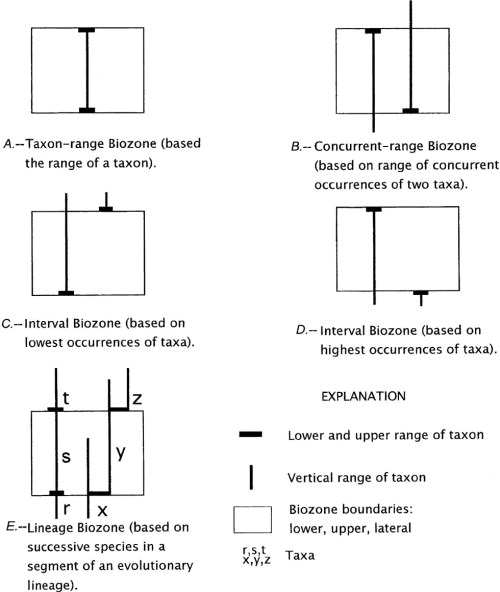
Figure 4--Examples of range, lineage, and interval biozones.
(d) Assemblage biozone.--An assemblage biozone (Fig. 5A)[ln5] is a body of rock
characterized by a unique association of three or more taxa, the association of which
distinguishes it in biostratigraphic character from adjacent strata. An assemblage biozone
may be based on a single taxonomic group, for example, trilobites, or on more than one
group, such as acritarchs and chitinozoans.
(e) Abundance biozone.--An abundance biozone (Fig. 5B) is a body of rock in which the abundance of a particular taxon or specified group of taxa is significantly greater than that in adjacent parts of the section. Abundance zones may be of limited, local utility because abundances of taxa in the geologic record are largely controlled by paleoecology, taphonomy, and diagenesis. The only unequivocal way to identify a particular abundance zone is to trace it laterally.
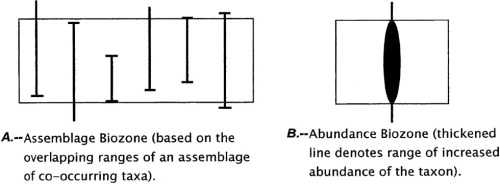
Figure 5--Examples of assemblage and abundance biozones.
(f) Hybrid or new types of biozones.--As specific problems are faced,
biostratigraphic analysis progresses, and new technologies appear, other forms of biozones
may prove useful and are not prohibited under this Code.
Article 51.--Boundaries. The boundaries of a biozone are drawn at surfaces that mark the lowest occurrence, highest occurrence, limit, increase in abundance, or decrease in abundance of one or more components of the (Begin page 374) fauna or flora. Furthermore, the base or top of one kind of biozone may not, or need not, coincide with the base or top of another kind of biozone.
Remark. (a) Identification of biozones.--Boundaries of range biozones are the
horizons of lowest and highest stratigraphic occurrence of the specified taxon or taxa.
Where two taxa are involved, the concurrent range biozone is present only where both taxa
are present. Boundaries of interval biozones are defined by two specified biostratigraphic
surfaces, in which case the base of one biozone commonly defines the top of the underlying
biozone. Boundaries of lineage biozones are determined by the biohorizons representing the
lowest occurrence(s) of successive elements in the evolutionary lineage under
consideration. Boundaries of assemblage biozones may be difficult to define precisely, but
such biozones are readily characterized and identified by the fully or partially
overlapping ranges of enclosed taxa or groups of taxa. In any one section, however, not
all characterizing taxa need be present to recognize the biozone, and the biozone may be
characterized or identified by other taxa. Boundaries of abundance biozones are defined by
marked changes in relative abundance of preserved taxa.
[Article 52 not used.]
RANKS OF BIOSTRATIGRAPHIC UNITS
Article 53.--Fundamental Unit. The biozone is the fundamental unit of
biostratigraphic classification.
Remark. (a) Scope.--A single body of rock may be divided into more than one kind of biozone. A biozone may be based on a single taxonomic group or on several different taxonomic groups. Biozone boundaries derived from one taxonomic group need not, and commonly do not, coincide with those of another taxonomic group. Biozones vary greatly in their stratigraphic thickness and geographic extent, and taxonomic refinement or revision may increase or decrease the extent of a biozone.
(b) Divisions.--A biozone may be completely or partly divided into subbiozones. All rules for defining and characterizing biozones are also applicable to subbiozones.
(c) Shortened forms of expression.--"Biozone" is a condensed
expression for "biostratigraphic zone." "Bio" should be used in front
of "zone" to differentiate it from other types of zones, but the unadorned term
"zone" may be used once it is clear that the term is a substitute for
"biozone." Furthermore, once it has been made clear which kind of biozone has
been employed, the descriptive term is not required to become part of the formal name; for
example, the Eurekaspirifer pinyonensis Assemblage Biozone can be designated
simply as the Eurekaspirifer pinyonensis Biozone. When a biozone is described for
the first time, however, the descriptive term should be capitalized, for example, Exus
albus Assemblage Biozone. Similarly, "subbiozone" may be shortened to
"subzone" where the meaning is clear.
BIOSTRATIGRAPHIC NOMENCLATURE
Article 54.--Establishing Formal Units. Formal establishment of a biozone must meet the requirements of Article 3 and requires a unique name, a description of its fossil content and stratigraphic boundaries, and a discussion of its spatial extent.
Remarks. (a) Name.--The name of a biozone consists of the name of one or more distinctive taxa or parataxa (for trace fossils) found in the biozone, followed by the word "Biozone" (e.g., Turborotalia cerrozaulensis Biozone or Cyrtograptus lundgreni-Testograptus testis Biozone). The name of the species whose lowest occurrence defines the base of the zone is the most common choice for the biozone name. Names of the nominate taxa, and hence the names of the biozones, conform to the rules of the international codes of zoological or botanical nomenclature or, in the case of trace fossils, internationally accepted standard practice.
(b) Shorter designations for biozones.--Once a formal biozone has been established, an abbreviation or alpha-numeric designation that represents the name of the biozone may be a convenient substitute. For example, the Icriodus woschmidti Biozone was termed the woschmidti Zone by Klapper and Johnson (1980), and the Rhombodinium porosum Assemblage Zone in the Barton Beds was termed BAR-3 by Bujak et al. (1980).
(c) Revision.--Biozones and subbiozones are established empirically and may be modified on the basis of new evidence. Positions of established biozone or subbiozone boundaries may be refined stratigraphically, new characterizing taxa may be recognized, or original characterizing taxa may be superseded. If the concept of a particular biozone or subbiozone is substantially modified, a new unique designation is desirable.
(d) Defining taxa.--When a biozone or subbiozone is formally described, or later emended, it is necessary to designate, or redesignate, the defining or characterizing taxa and/or to document the lowest occurrences, highest occurrences, or other biohorizons that mark the biozone or subbiozone boundaries.
(e) Reference sections.--Biostratigraphic units do not have stratotypes in the
sense of Article 3, item (iv), and Article 8. Nevertheless, it is desirable to designate a
reference section in which the biostratigraphic unit is characteristically developed.
53. Salvador, A., ed., 1995, International Stratigraphic Guide, 2d ed.: International Union of Geological Sciences and Geological Society of America, 214 p.
54. George, T. N., et al., 1969, Recommendations on stratigraphical usage: Proceedings of the Geological Society of London, no. 1656, p. 139-166.
(Begin page 375)
55. Klapper, G., and J. G. Johnson, 1980, Endemism and dispersal of Devonian conodonts: Journal of Paleontology, v. 54, p. 400-455.
56. Bujak, J. P., C. Downie, G. L. Eaton, and G. L. Williams, 1980, Dinoflagellate cyst zonation of the Eocene, southern England, in J. P. Bujak, C. Downie, G. L. Eaton, and G. L. Williams, Dinoflagellate cysts and acritarchs from the Eocene of southern England: Special Papers in Palaeontology 24, p. 15-26.
REFERENCES CITED
Salvador, A., ed., 1995, International Stratigraphic Guide, 2d ed.: International Union of Geological Sciences and Geological Society of America, 214 p.
View the First Page
A text abstract of this article is not available. The first page of the PDF appears below.
You may download the first page as a PDF.

Pay-Per-View Purchase Options
The article is available through a document delivery service. Explain these Purchase Options.
| Watermarked PDF Document: $16 | |
| Open PDF Document: $28 |
AAPG Member?
Please login with your Member username and password.
Members of AAPG receive access to the full AAPG Bulletin Archives as part of their membership. For more information, contact the AAPG Membership Department at [email protected].