
The AAPG/Datapages Combined Publications Database
AAPG Bulletin
Figure
AAPG Bulletin; Year: 2018; Issue: June DOI: 10.1306/08291717097
Return to Full Text
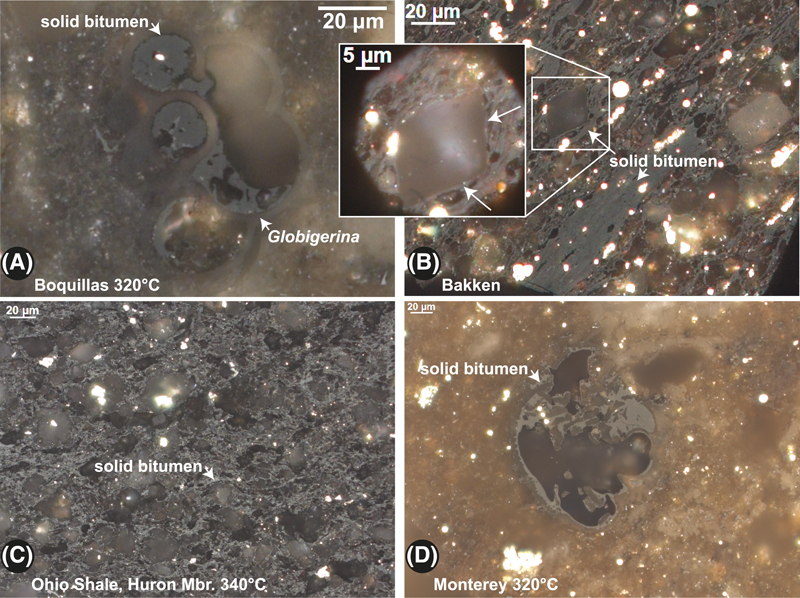
Figure 2. Photomicrographs of example textures used to identify solid bitumen in shale sample starting materials and hydrous-pyrolysis residues. (A) Solid bitumen filling chambers of Globigerina foraminifera in Boquillas Formation (Eagle Ford Formation equivalent) marl in 320°C hydrous-pyrolysis residue (solid-bitumen reflectance [BRo] of 0.52%). (B) Solid bitumen as a groundmass and embayed by euhedral mineral faces (arrows pointing to solid bitumen at margins of carbonate in inset) in the Bakken Shale starting material (BRo of 0.32%). From Hackley and Cardott (2016). (C) Solid bitumen as a groundmass in the Ohio Shale Huron Member (Mbr.) in 340°C hydrous-pyrolysis residue (BRo of 1.02%). (D) Solid bitumen associated with foraminifera in Monterey Formation 320°C hydrous-pyrolysis residue (BRo of 0.61%).
Figure 2. Photomicrographs of example textures used to identify solid bitumen in shale sample starting materials and hydrous-pyrolysis residues. (A) Solid bitumen filling chambers of Globigerina foraminifera in Boquillas Formation (Eagle Ford Formation equivalent) marl in 320°C hydrous-pyrolysis residue (solid-bitumen reflectance [BRo] of 0.52%). (B) Solid bitumen as a groundmass and embayed by euhedral mineral faces (arrows pointing to solid bitumen at margins of carbonate in inset) in the Bakken Shale starting material (BRo of 0.32%). From Hackley and Cardott (2016). (C) Solid bitumen as a groundmass in the Ohio Shale Huron Member (Mbr.) in 340°C hydrous-pyrolysis residue (BRo of 1.02%). (D) Solid bitumen associated with foraminifera in Monterey Formation 320°C hydrous-pyrolysis residue (BRo of 0.61%).