
The AAPG/Datapages Combined Publications Database
AAPG Bulletin
Figure
AAPG Bulletin; Year: 2025; Issue: April DOI: 10.1306/03182524012
Return to Full Text
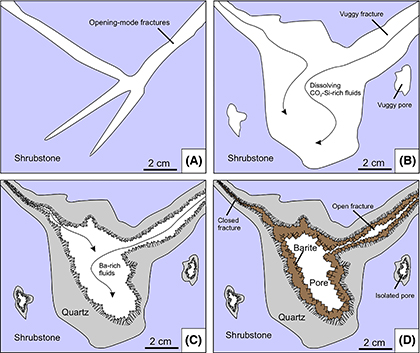
Figure 16. Mechanism to form and preserve mineralized vuggy fractures and vuggy pores. (A) Deformed host rock with opening-mode fractures showing straight walls. (B) Vuggy fracture enlarged by dissolving fluids rich in silica and mantle volatiles (CO2 included) that promoted host rock dissolution. (C) Quartz covers vugs and fracture walls; narrow fractures are filled first, and large fractures are still open, leaving fluid pathways to Ba-rich fluids. (D) Barite covers the geode and vuggy fracture; remaining porosity is only preserved in large cavities forming geodes and the large vuggy fractures coated by euhedral cements, whereas narrow fractures are pervasively cemented, preventing new incoming fluid flow. Vuggy pores that became isolated from the pore network during quartz cementation do not show barite cementation.
Figure 16. Mechanism to form and preserve mineralized vuggy fractures and vuggy pores. (A) Deformed host rock with opening-mode fractures showing straight walls. (B) Vuggy fracture enlarged by dissolving fluids rich in silica and mantle volatiles (CO2 included) that promoted host rock dissolution. (C) Quartz covers vugs and fracture walls; narrow fractures are filled first, and large fractures are still open, leaving fluid pathways to Ba-rich fluids. (D) Barite covers the geode and vuggy fracture; remaining porosity is only preserved in large cavities forming geodes and the large vuggy fractures coated by euhedral cements, whereas narrow fractures are pervasively cemented, preventing new incoming fluid flow. Vuggy pores that became isolated from the pore network during quartz cementation do not show barite cementation.